
News article from Faïg Abbasov
Around 600 million people in #Africa still lack reliable access to #electricity, which is nearly half the continent’s population and more than 80 per cent of the global electricity access gap.
It is a terrible situation, but it is a solvable one; Africa’s #solar and #wind potential is immense! But it needs massive #investment, and developed economies have been consistently failing to deliver (on time) financial support pledged over the years, while domestic financial potential is limited.
There is potentially good news. #Maritime transport offers a new innovative source of #Sovereign revenues for most African countries through national #carbon #taxation (#carbon_pricing).
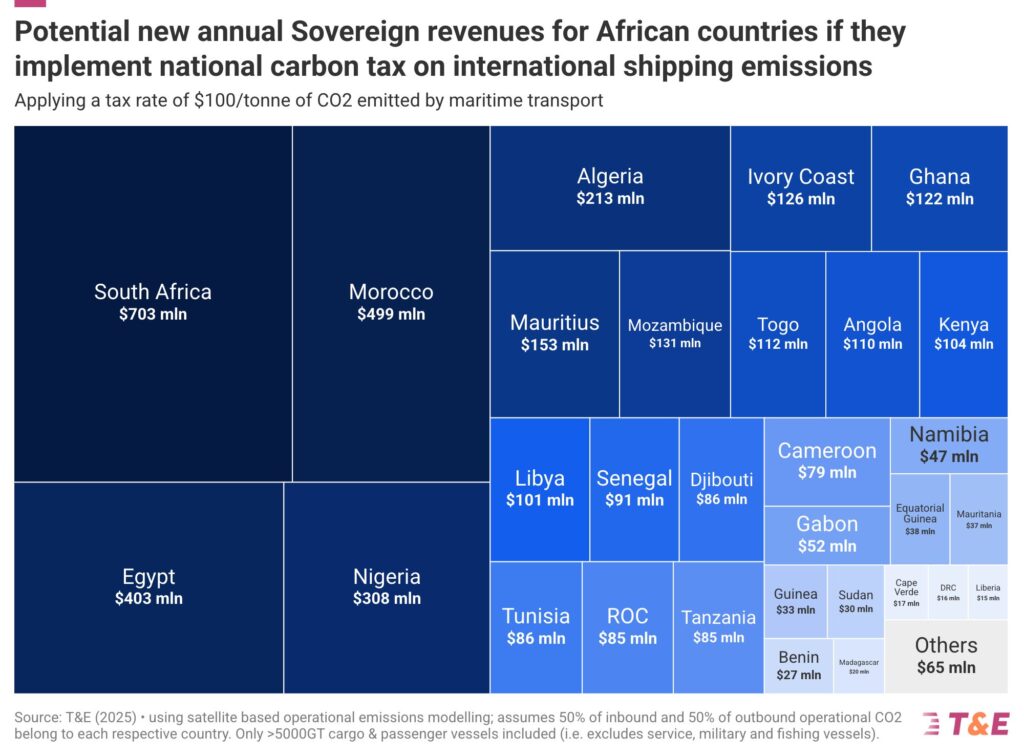
Large seagoing #ships emit about 40 million tonnes of CO2 on voyages related to African countries and with a carbon tax of $100/tonne CO2, it can generate nearly $4 billion/year in new sovereign revenues. A $17/tonne CO2 is also a good starting point, with total annual revenues almost $700/million a year.
T&E satellite based emissions model allows visualising total potential revenues per country if maritime emissions attribution follows the same methodology as the EU maritime #ETS covering 50% inbound, 50% outbound and all in-port maritime emissions.
What does it entail?
Simply requiring ships (under port state control) to monitor emissions on voyages to and from each African country, and pay $[XXX]/tonne CO2 carbon tax on those emissions. Africa Sovereign Carbon Registry Foundation seemingly offers a similar operational model.
EU maritime ETS has been a success as a climate tool, but also in generating new revenues for climate investment. Europe (Wopke Hoekstra, EU Environment and Climate) should support Africa on this journey, on which Djibouti and Gabon have already taken the first brave steps. Others should follow if maritime transport is to contribute to #just and #equitable #climate and #energy #transition in Africa.